Procurement and Supply Chain Salaries in Saudi Arabia and GCC: 2025-2026 Benchmark Guide
9 July 2026 - 6 min read
Procurement and Supply Chain Salaries in Saudi Arabia and GCC: 2025–2026 Benchmark Guide
By EzWorkers Market Research Desk | Last Updated: July 2026
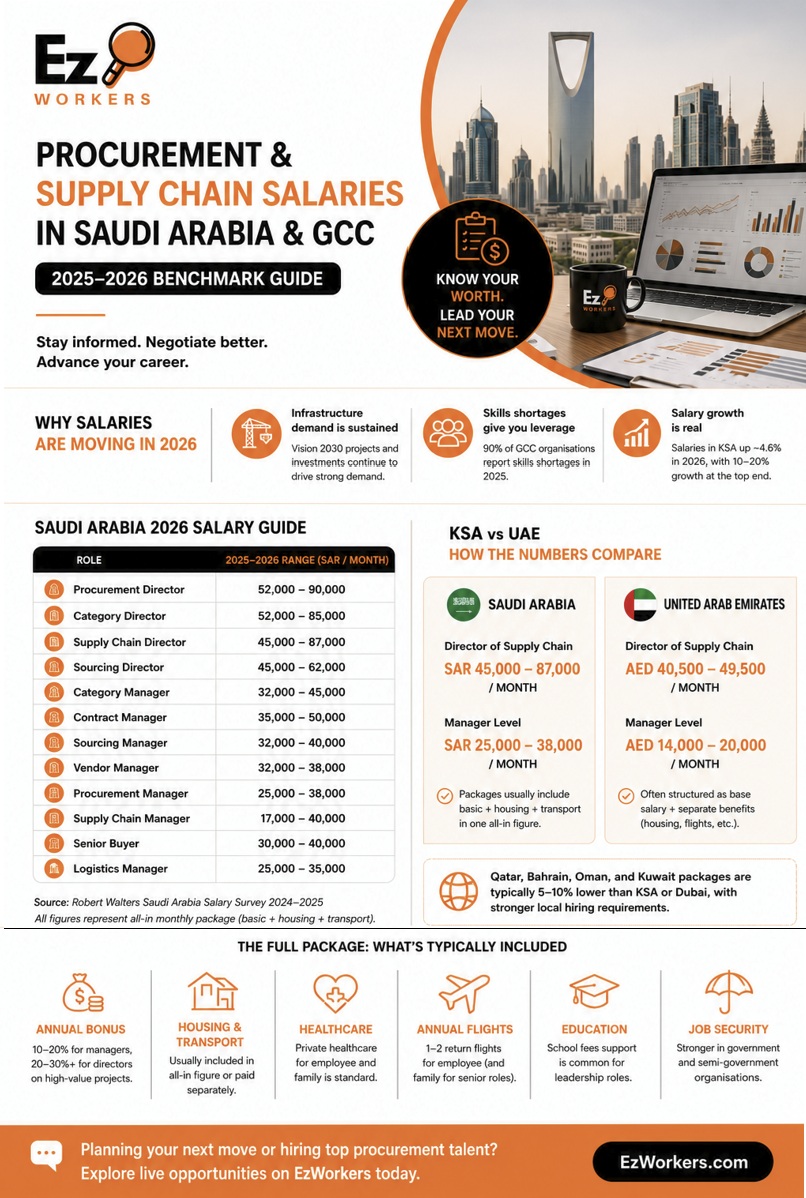
Procurement and supply chain professionals in Saudi Arabia and the wider GCC can expect monthly packages ranging from SAR 25,000 to SAR 90,000 depending on seniority, sector, and location, based on 2025–2026 data compiled from Robert Walters, Hays, and Barclay Simpson salary surveys. Director-level roles sit at the top of that band; manager-level roles cluster between SAR 25,000 and SAR 38,000 per month. This guide breaks down the exact figures by role, explains what is driving salary movement this year, and gives practical guidance on how to read an offer.
Why Procurement Salaries Are Moving in 2026
Three forces are shaping what employers are willing to pay right now.
Infrastructure demand is sustained. Vision 2030 giga-projects, PIF-backed company expansions, and government infrastructure programmes continue to generate procurement roles in construction, EPC, and manufacturing. Even as some mega-project timelines have been adjusted, the underlying pipeline of procurement work remains large enough to keep talent demand firm in Riyadh and Jeddah.
Skills shortages give experienced professionals leverage. The Hays GCC Salary Guide 2026 found that 90% of organisations reported skills shortages in 2025. Within supply chain and logistics specifically, demand for vendor management, strategic sourcing, and contract management skills consistently outpaces available talent. Employers recruiting for senior roles know they are competing.
Salary growth is real but moderate. Salaries across Saudi Arabia are projected to increase by around 4.6% in 2026, slightly ahead of the UAE at 4.1%. That headline masks wider variation: specialist and director-level procurement roles are seeing upper-end package growth of 10–20%, while generalist roles remain closer to the 2–5% range. For procurement professionals with multi-sector backgrounds and strong contract governance experience, the market is favourable for a move.
Role-by-Role Salary Table: Saudi Arabia 2026
The figures below are monthly all-in packages covering basic salary, housing allowance, and transport allowance. Source: Robert Walters Saudi Arabia Salary Survey (2024 vs 2025).

Source: Robert Walters Saudi Arabia Salary Survey 2024–2025. Figures represent all-in monthly package (basic + housing + transport).
A few things worth noting. The Procurement Manager band (SAR 25,000–38,000) has seen upward movement at its top end over the past 12 months, driven by skills shortages and increased project-driven demand. Roles tied to direct strategic sourcing in construction and EPC sit at the upper half of any range. Supply Chain Director carries the widest band in the table because the role definition varies significantly across organisations: a standalone SCM function at a mid-sized company and a group supply chain director at a PIF portfolio entity are both captured within it.
KSA vs UAE: How the Numbers Compare
The UAE market benchmarks broadly in line with Saudi Arabia on procurement packages, with some structural differences in how total compensation is presented.
A Director of Supply Chain in the UAE earns between AED 40,500 and AED 49,500 per month, which at current exchange rates places it in a similar bracket to the KSA range of SAR 45,000–87,000 for equivalent seniority. At manager level, UAE procurement packages typically run AED 14,000–20,000 per month.
The key practical difference is how packages are structured. In Saudi Arabia, the conventional format bundles basic, housing, and transport into a single quoted figure. International firms operating in UAE free zones, particularly DIFC and ADGM, are increasingly moving to a UK-style base-salary-plus-separate-benefits model. In those cases, the headline number looks smaller but school fees, flights, and housing allowances are often added on top. Always read an offer in terms of net annual take-home value rather than the monthly figure quoted in the job description.
For other GCC markets: Qatar, Bahrain, Oman, and Kuwait tend to offer packages 5–10% lower than KSA or Dubai, and stronger nationalisation requirements can limit the number of senior international roles available.
The Full Package: Bonuses and Benefits
Base salary is only part of the story. Here is what the market typically offers at procurement manager and director level across the GCC.
Annual bonus: The Barclay Simpson 2026 Middle East survey found that 22% of professionals received a bonus of 21–30% of salary, and 17% received 11–20%. For director-level procurement roles on high-value projects, bonuses can run higher. The typical market expectation for a Procurement Manager is 10–20% of base; for directors, 20–30% is a defensible negotiating position.
Housing and transport: In most Saudi and UAE offers, these are included in the all-in figure. Where they are listed separately, housing typically runs SAR 3,000–8,000 per month for managers and higher for directors, depending on city and company size.
Healthcare: Private healthcare covering the employee and immediate family is standard for manager level and above across KSA and UAE.
Annual flights: One or two return economy flights for the employee (and family tickets for senior roles) is a common benefit for expatriate professionals.
School fees: For director-level expatriates, a partial or full contribution to school fees, often SAR/AED 30,000–50,000 per child annually, is negotiable at large organisations, PIF entities, and international firms with established expatriate benefit structures.
End-of-service gratuity: In the UAE, approximately one month of base salary per year of service applies at employment end. Saudi Arabia has its own labour law gratuity schedule. This is a real financial figure worth quantifying when evaluating any multi-year role.
What Employers Are Actually Looking For in 2026
Hiring managers in procurement and supply chain are consistently prioritising certain profiles. These are the areas to foreground in a CV and at interview.
Multi-sector experience. Candidates who have worked across construction, EPC, manufacturing, or FMCG are more attractive than specialists in a single vertical. The ability to transfer procurement governance frameworks across sectors is a real differentiator in interviews.
Contract and governance depth. End-to-end command of tendering, RFQ, contract award, supplier performance management, and closeout. Not just buying experience; the full contract lifecycle matters.
Saudisation support. 75% of KSA employers plan to further increase Saudi national headcount in 2026. Candidates who have previously managed or developed national talent, or who can credibly support a Saudisation agenda within a procurement team, are in a measurably stronger position.
Digital and systems literacy. Oracle, SAP Ariba, and equivalent ERP experience is a baseline expectation at manager level. Procurement leaders who can produce cost-saving reports, supplier risk dashboards, or spend analytics are better positioned as organisations upgrade their procurement technology stacks.
How to Use This Data in Your Next Salary Negotiation
The Hays GCC Salary Guide 2026 found that 60% of professionals feel their pay does not match their responsibilities. That gap is usually widest at manager level, where the role scope is significant but the package outcome varies enormously depending on sector, company, and how the negotiation is handled.
Negotiate on total package value, not base salary alone. A role with a lower base but strong bonus, housing, and school-fee support can easily outperform a higher-base offer with minimal benefits on a net annual basis. Build the comparison in full before accepting or declining.
Sector positioning matters more than title. A Procurement Manager at a PIF-backed EPC contractor in Riyadh earns a different rate than the same title at a smaller trading company. The same job title in the same city can span SAR 13,000 per month in range. Know which part of the band your target employer sits in before the negotiation begins.
Signing incentives exist but have moderated. Barclay Simpson noted that generous relocation packages have become less common relative to 2022–2023. Cash signing bonuses are still offered for hard-to-fill director roles but are not the norm at manager level. Where available, treat them as a one-off negotiation item rather than trying to embed them in recurring base.
Career progression now weighs heavily in candidate decisions. The proportion of GCC professionals citing remuneration as their primary driver dropped from 56% in 2024 to 38% in 2025, with career development rising from 15% to 34% in the same period. If the role offers PIF exposure, category leadership, or regional scope, those factors belong in the negotiation as value you are consciously choosing, not as concessions.
Frequently Asked Questions
What is the average procurement manager salary in Saudi Arabia in 2026?
The Robert Walters survey puts the all-in monthly package for a Procurement Manager in KSA at SAR 25,000–38,000, with the upper end reflecting 8+ years of experience in construction, EPC, or manufacturing. Annualised, this equates to approximately SAR 300,000–456,000. Payscale data from mid-2026 shows a median annual total compensation of around SAR 232,000 from a smaller self-reported sample, which likely skews lower due to sample composition.
How much does a procurement director earn in KSA?
Director-level roles (Procurement Director, Category Director, Supply Chain Director) range from SAR 45,000 to SAR 90,000 per month all-in, based on Robert Walters 2025 data. The top end is typically reached at PIF entities, large EPC companies, and multinationals with extensive category portfolios. Annual bonuses of 20–30% of base are common at this level.
Do procurement professionals in the UAE earn more than in Saudi Arabia?
Not significantly when compared on a like-for-like basis. UAE packages at director level (AED 40,500–49,500 per month) are comparable to KSA equivalents. The structural difference is how packages are presented: KSA typically bundles housing and transport in the quoted figure, while UAE free-zone offers often separate them. Net take-home is broadly similar; both markets offer tax-free income.
Which sectors pay the highest procurement salaries in Saudi Arabia?
Oil and gas, EPC construction, and PIF-portfolio manufacturing companies consistently pay at the top of the range. The complexity of their supply chains, the scale of their procurement contracts, and the strategic importance of the function all justify premium packages. Retail and FMCG procurement roles generally sit at the lower end of each band.
What certifications increase procurement salary in GCC?
CIPS (Chartered Institute of Procurement and Supply) qualification at L5 or L6 is recognised across the GCC and is a meaningful differentiator in senior hiring. CPSM (Certified Professional in Supply Management) carries weight with US-headquartered organisations. For roles with a strong construction or EPC component, FIDIC contract knowledge and demonstrated experience with NEC or FIDIC Red Book frameworks is a practical value-add beyond formal certification.
Is it a good time to look for a procurement job in Saudi Arabia in 2026?
Yes, particularly for experienced professionals with 7+ years covering strategic sourcing, contracts, and vendor management in construction or manufacturing. 66% of GCC employers increased headcount in 2025 and 90% reported skills shortages. That combination currently favours candidates with a strong track record. Whether you are making a first move to KSA or stepping up within the market, active roles are in the market.
Find Procurement and Supply Chain Jobs in GCC
EzWorkers aggregates procurement, supply chain, and logistics jobs across KSA, UAE, Qatar, and the wider GCC from verified sources, updated every six hours. Whether you are targeting a Procurement Manager role in Riyadh or a Supply Chain Director position in Dubai, the listings are available without a paywall or registration requirement.
Browse Procurement Jobs in Saudi Arabia →
Browse Supply Chain Jobs in UAE →
Sources: Robert Walters Saudi Arabia Salary Survey 2024–2025; Hays GCC Salary Guide 2026 (via Zawya); Barclay Simpson Middle East Salary and Bonus Survey 2026; Payscale (Procurement Manager, Saudi Arabia, 2026); Naukrigulf Salary Benchmarks 2025. All salary figures cited reflect the original published survey data without modification.