Qiwa and Iqama in Saudi Arabia: The Complete 2026 Guide | EzWorkers
19 September 2026 - 4 min read
Qiwa and Iqama in Saudi Arabia: The Complete 2026 Guide for Employees and Employers
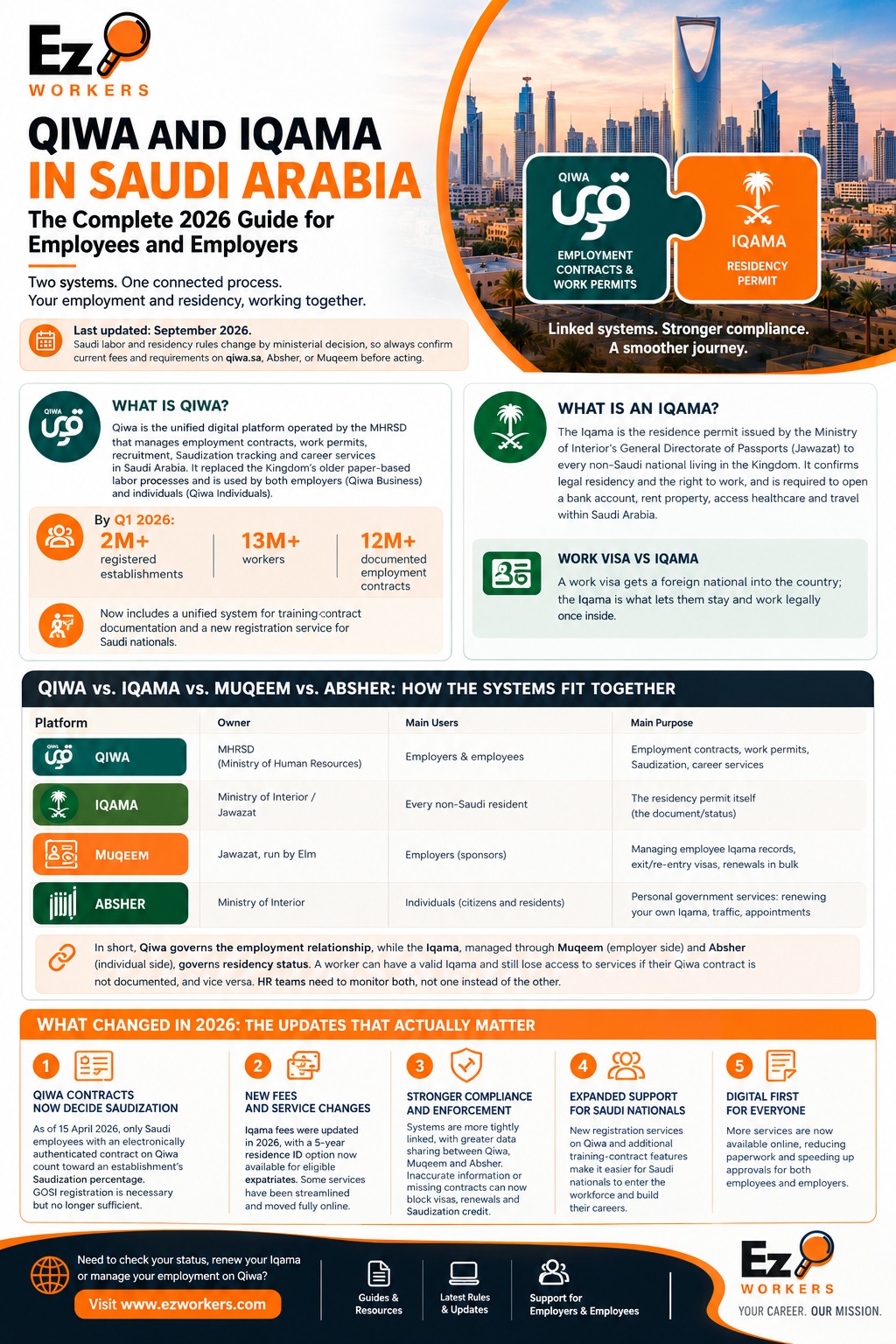
Qiwa is the Saudi government's digital labor platform, and the Iqama is the residency permit that lets a foreign national live and work in the Kingdom. They are two different systems that now function as one connected process: your Iqama proves you are a legal resident, and your Qiwa contract proves your employment is documented and recognized by the Ministry of Human Resources and Social Development (MHRSD). Since April 2026, the two are linked more tightly than ever, and getting either one wrong can now block visas, renewals, and even Saudization credit for an employer.
This guide walks through what each system does, how they interact, and every major change introduced in 2026 that job seekers, expatriate employees, HR teams, and business owners in Saudi Arabia need to know.
Last updated: September 2026. Saudi labor and residency rules change by ministerial decision, so always confirm current fees and requirements on qiwa.sa, Absher, or Muqeem before acting.
What Is Qiwa?
Qiwa is the unified digital platform operated by the MHRSD that manages employment contracts, work permits, recruitment, Saudization tracking, and career services in Saudi Arabia. It replaced the Kingdom's older paper-based labor processes with a single online system used by both employers ("Qiwa Business") and individuals ("Qiwa Individuals").
By the first quarter of 2026, Qiwa had passed 2 million registered establishments, 13 million workers, and 12 million documented employment contracts, and the Ministry had added a unified system for training-contract documentation along with a new registration service for Saudi nationals during the same quarter.
What Is an Iqama?
The Iqama is the residence permit issued by the Ministry of Interior's General Directorate of Passports (Jawazat) to every non-Saudi national living in the Kingdom. It confirms legal residency and the right to work, and it is required to open a bank account, rent property, access healthcare, and travel within Saudi Arabia. A work visa gets a foreign national into the country; the Iqama is what lets them stay and work legally once inside.
Qiwa vs. Iqama vs. Muqeem vs. Absher: How the Systems Fit Together
These four names get mixed up constantly, and understanding the split matters for anyone hiring or working in Saudi Arabia.

In short, Qiwa governs the employment relationship, while the Iqama, managed through Muqeem (employer side) and Absher (individual side), governs residency status. A worker can have a perfectly valid Iqama and still lose access to services if their Qiwa contract is not documented, and vice versa. HR teams need to monitor both, not one instead of the other.
What Changed in 2026: The Updates That Actually Matter
1. Qiwa Contracts Now Decide Saudization, Not Just GOSI
The single biggest shift of the year: as of 15 April 2026, only Saudi employees with an electronically authenticated contract on Qiwa count toward an establishment's Saudization percentage. GOSI registration used to be enough for Nitaqat credit; it is now necessary but no longer sufficient. The Saudi employee must log into Qiwa Individuals and digitally accept the contract before it counts. Establishments that skip this step risk an immediate downgrade in their Nitaqat color band (Platinum, High Green, Mid Green, Low Green, Red), along with visa blocks, Iqama renewal restrictions, and suspended service transfers.
2. Documentation Targets Jumped to 85% and Then 90%
The Ministry raised the required employment-contract documentation rate twice in 2026: establishments had to reach 85% documentation by 30 April 2026, then 90% by 30 June 2026. Falling short does not trigger an automatic fine, but it can delay or restrict access to services tied to compliance, including visa issuance, employee transfers, and profession changes.
3. A 5-Year Physical Iqama Card, Annual Renewal Unchanged
Saudi Arabia introduced a Muqeem Resident ID card that stays physically valid for five years from issuance, ending the old annual reprint cycle. This is an administrative change only: the underlying residency status must still be renewed electronically, typically every 12 months (or in 3, 6, or 9-month blocks where flexible renewal applies). A card that looks unexpired can still sit on an inactive residency in the system, so checking Absher or Muqeem status directly still matters more than checking the card's printed date. New cards are delivered by the Wasil postal service to the resident's registered National Address, with no walk-in collection option, which makes keeping that address current a practical necessity rather than a formality.
4. Expired-Permit Cleanup Rule for Non-Saudi Workers
Employers must cancel the registration of non-Saudi employees whose work permits have expired, or who have been absent for more than three months, after 30 June 2026, regardless of the worker's residency status. This is part of a broader push to keep workforce records accurate and to align Qiwa, Muqeem, and Absher data.
5. Transfers Are Now Possible Even With an Expired Iqama
Under the 2026 rules, an employee transfer can proceed even if the Iqama has expired, provided the new employer pays the late-renewal fines and initiates the transfer through Qiwa. This closes a gap that previously left workers with lapsed permits unable to move employers at all.
Iqama Fees in 2026: What Employers and Employees Actually Pay
Iqama costs are not one number, they are several components paid by different parties. Based on the most recent published figures:

Under Article 40 of the Saudi Labor Law, the employer, not the employee, is legally responsible for the Iqama fee, the Absher processing fee, and the work permit levy. If an employer asks a worker to cover these out of pocket, that is a labor law violation the worker can report through MHRSD. Dependent fees are the one component commonly (though not universally) passed to the employee, so this should always be clarified in writing before accepting an offer with family status.
How Employees Use Qiwa: A Practical Walkthrough
- Log in to the Qiwa Individuals account using the National Single Sign-On (the same credentials used for Absher).
- Open the notifications or contracts section and locate any pending employment contract.
- Compare every field, salary, job title, contract duration, working hours, allowances, against the signed offer letter.
- Approve the contract only if every detail matches. Reject it or request an amendment if something is wrong.
- Save a copy of the final documented contract for personal records.
- Check the dashboard periodically for transfer offers, amendment requests, or compliance notices, since these are time-sensitive.
An employee should never approve a contract just because an employer sent it. Since 2024, the Qiwa contract has been the only version recognized in labor disputes, so approving it confirms the terms are correct, not just that the paperwork arrived.
How Employers Use Qiwa: A Practical Walkthrough
- Confirm the establishment's commercial registration and Qiwa business account are active.
- Select the correct establishment if the company operates under a unified number with multiple branches.
- Enter the employee's contract details (job title, salary, duration, benefits) and send it for approval.
- Track whether the employee has approved, rejected, or requested changes.
- Reconcile Qiwa records against payroll, GOSI, and Mudad (Wage Protection System) data monthly.
- Monitor the establishment's Nitaqat color band, since it now depends directly on documented Qiwa contracts for Saudi staff, not GOSI registration alone.
- Review work permits, transfer requests, and expired-permit cases quarterly, and process the mandatory cancellations for lapsed or long-absent non-Saudi employees.
Common Mistakes to Avoid
- Approving a Qiwa contract without checking it against the offer letter. Once approved, that version becomes the legally recognized record.
- Assuming GOSI registration alone protects Nitaqat status. As of April 2026, it does not; the Qiwa contract must also be authenticated.
- Treating the 5-year Iqama card as proof of active residency. The card's physical validity and the underlying residency status are two different things; always verify status in Absher or Muqeem, not just the card.
- Ignoring pending Qiwa notifications. A single unanswered transfer offer or amendment request can stall recruitment or mobilization for weeks.
- Letting the National Address lapse. Since resident ID cards are now mailed rather than collected in person, an outdated address means the card may never arrive.
- Assuming the employee pays Iqama or work permit fees. Under Article 40, that responsibility sits with the employer by default.
Frequently Asked Questions
Is Qiwa the same as Iqama? No. Qiwa is the employment and labor-compliance platform run by the Ministry of Human Resources. The Iqama is the residency permit itself, issued by the Ministry of Interior. They are connected but managed by different government bodies.
Does a documented Qiwa contract replace the Iqama? No. A worker needs both: a valid Iqama to reside and work legally, and a documented Qiwa contract for the employment relationship to be recognized and for the employer to receive Saudization credit where applicable.
How much does Iqama renewal cost in 2026? The base renewal fee is SAR 650 per year for company and institution employees and SAR 600 for domestic workers, plus a SAR 51.75 Absher processing fee per transaction. Employers separately pay a monthly work permit levy of SAR 700 to SAR 800 per employee, and dependents carry a further SAR 400 per month each.
What happens if my Iqama expires while I am changing employers? As of the 2026 rules, a transfer can still go through on an expired Iqama, but the new employer must pay the late-renewal penalties and start the transfer through Qiwa.
Who pays Iqama and work permit fees, the employer or the employee? Under Article 40 of the Saudi Labor Law, the employer is responsible for the Iqama fee, the Absher processing fee, and the work permit levy. Dependent fees are the exception and are commonly, though not always, paid by the employee.
Why did my company's Nitaqat rating change even though nothing else changed? Since 15 April 2026, Nitaqat scoring only counts Saudi employees whose contracts are electronically authenticated on Qiwa. A rating drop with no other change usually means one or more Saudi staff contracts are not yet approved on the platform.
Final Word
Qiwa and Iqama used to be treated as separate boxes to tick, one for HR and one for the accommodation or visa file. In 2026, they function as a single compliance chain: an accurate Iqama status, a documented Qiwa contract, and a correctly classified Nitaqat rating now determine whether an employer can hire, transfer, or renew at all. For job seekers and employers navigating the Saudi and wider GCC labor market, staying current on both systems is no longer optional paperwork, it is part of doing business in the Kingdom.
Browse current job openings across Saudi Arabia and the GCC on EzWorkers, or check back for updated guides as MHRSD and the Ministry of Interior continue to roll out changes through the rest of 2026.